
 TICKETS
 DONATE




Gila Monster
About
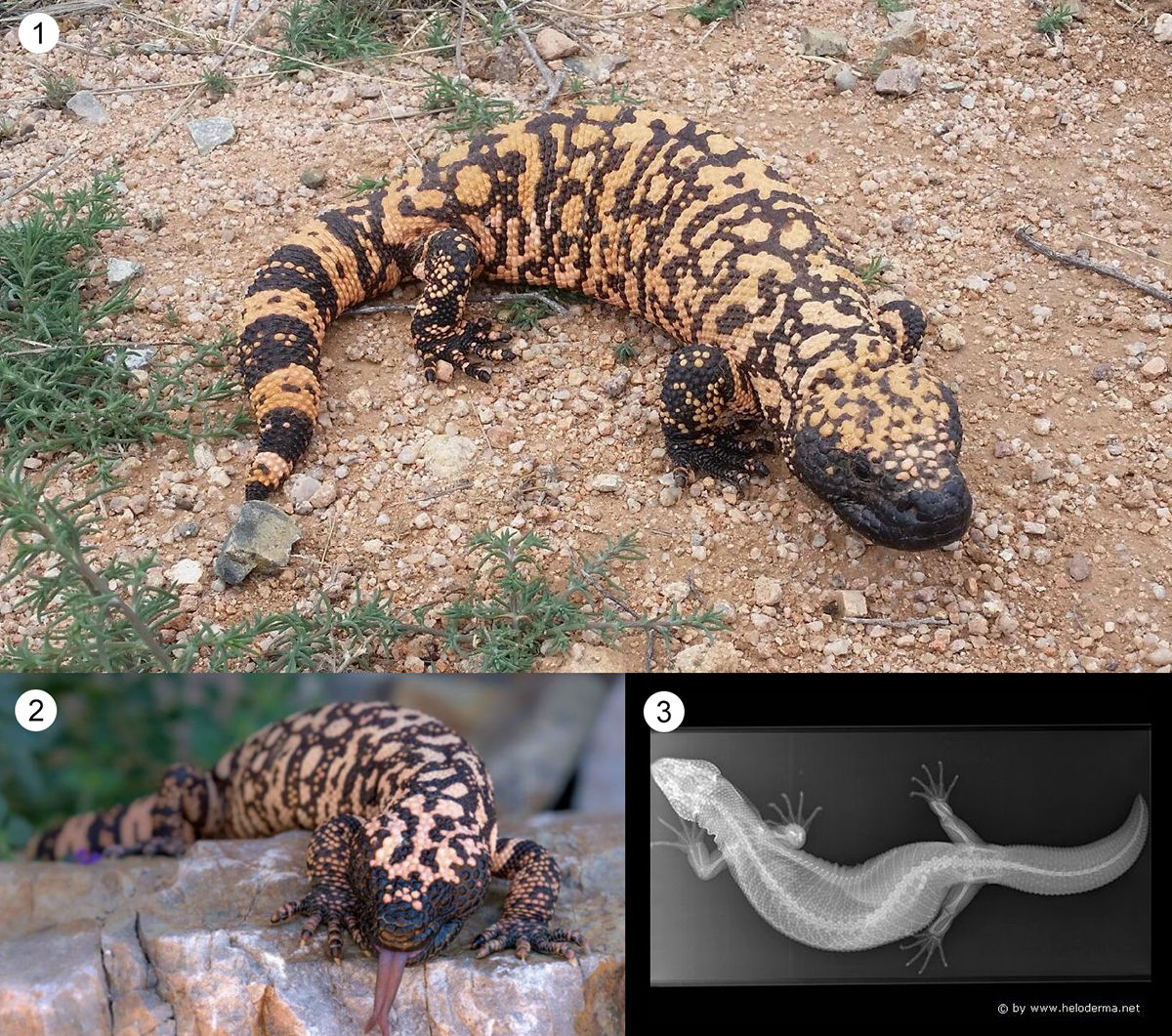
AHHH! A MONSTER?! Yes, but don’t worry. Gila (pronounced HEE-luh) monsters aren’t the kind of monster that lives under your bed or in your closet. These desert dwellers spend most of their lives (about 95%) hidden away in burrows. Gentle giants by nature, Gila monsters are the largest lizard in the United States. They are stocky and covered in a distinctive pattern that is black and pink, orange, or yellow. The most dangerous thing about these critters for humans is that learning about them is a monstrously good time!
Adaptations
Gila monsters are so well adapted to desert living that their bodies haven’t changed much over the tens of thousands of years that they have existed. They are even referred to as living fossils. These critters do just about everything slowwwwly. Having movement and digestion that is unhurried allows these animals to conserve their energy. Additionally, Gila monsters are ectothermic meaning they conserve energy by using the environment to regulate their body temperature. If a Gila monster needs to warm up, they move into the sun instead of wasting energy shivering like mammals do.
With these critters moving so slowly, they need to be able to protect themselves. Luckily, there are several adaptations that Gila monsters have that allow them to survive at their own pace. Their first line of defense is aposematic coloration (sometimes called warning colors). When another animal sees the bright pattern of a Gila monster, they steer clear. Just underneath this protective coloration Gila monsters have special armor called osteoderms (See image 4). These bony growths provide an extra layer of protection. In this hot desert environment, osteoderms also serve an important role in helping Gila monsters absorb or push away heat.
The most famous adaptation that Gila monsters have for protection is their venom. Before they bite, Gila monsters will perform a threatening display where they open their mouths wide and hiss (listen!); if this display does not scare off the target, they might bite. Venom glands along their bottom jaws push venom up into the Gila monster’s mouth where it mixes with saliva as it travels along special groves in the teeth. These animals have an extremely strong bite and will hold on and chew in order to distribute as much venom as possible. There are many myths about how long a Gila monster will bite, but the reality is that they will let go once they feel that they are no longer in danger.
Food Web
Gila monsters are carnivores, but they aren’t ferocious hunters. They use their forked tongue to meander towards the smells of their prey. These critters have long claws that allow them to climb rocks, cacti, and walls in pursuit of their meal. Gila monsters do most of their eating in spring, which is when other animals are having babies, and their diet consists primarily of critters that can’t protect themselves like baby rabbits or rodents and bird or reptile eggs. They will occasionally eat small mammals, frogs, arthropods, birds, snakes, lizards, and even carrion.
Gila monsters can go a very long time without eating, and it’s thought that they can eat all the food needed for a whole year in just three to four large meals! Adults can eat up to 35% of their body weight in one sitting and the young can eat up to 50%. Additionally, these animals get most of their water through their food, so they don’t need to drink very often. Fat is stored in their thick tail and used when food is scarce.
Despite their venomous defense, Gila monsters are often eaten by other animals. Young Gila monsters are particularly vulnerable due to their small size and lack of life experience; snakes such as king snakes are big fans of these tasty treats! Adults are predated by large carnivorous birds, coyotes, and even badgers.
Habitat and Range
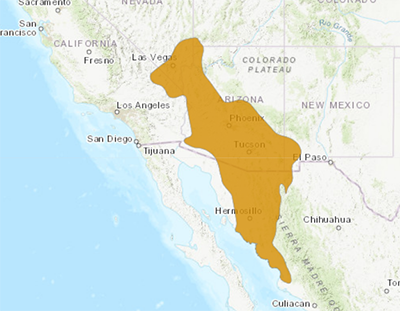
Gila monsters are desert dwellers and are found in three of the four North American deserts (though the Sonoran Desert makes up the bulk of their range). These lizards can be found throughout southwestern portions of Arizona, Southern Nevada, Southwestern Utah, Eastern California, Southern New Mexico, and down into Sinaloa, Mexico. They are primarily found in rocky foothills with shrubbery.
Map: NatureServe and IUCN (International Union for Conservation of Nature) 2007. Heloderma suspectum. The IUCN Red List of Threatened Species. Version 2022-2
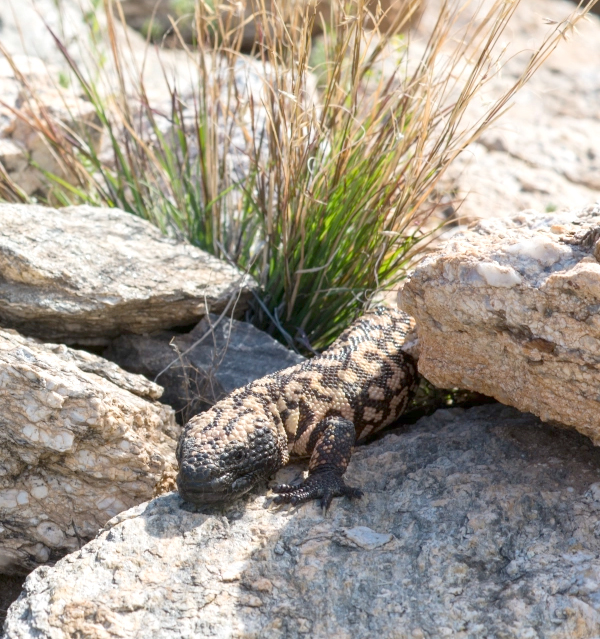
ASDM/Frankie Casalenuovo
Family Life
Most of a Gila monster’s life is spent alone in their burrow, but in spring when food is most abundant these critters go looking for a mate. Males search for females by using their forked tongue to follow the scent. If multiple males find the same female, they will wrestle! Whichever male can pin the other down will get the opportunity to mate. Females lay two to 12 eggs in burrows where they are covered by dirt and incubated by the sun. Depending on weather patterns, eggs will either hatch in four months or stay underground during winter and hatch the following spring.
Glossary
- Ectothermic:
- Cold-blooded; relying on outside circumstances to regulate body temperature.
- Aposematic Coloration:
- Bright or contrasting color patterns that communicate toxicity.
- Osteoderms:
- Bony growth just below the skin surface that helps with protection and temperature regulation.
- Carnivore:
- An animal that only eats other animals.
- Arthropod:
- An organism with an exoskeleton, jointed legs, and segmented body.
- Carrion:
- The decaying flesh of dead animals.
Fun Facts
- Gila monster venom has been incredibly influential in medicine! The hormones found within the venom are what inspired the creation of semaglutide which is used in medications for type two diabetes and/or weight loss.
- There are two different types of patterns that Gila monsters can have — reticulated (splotchy pattern) or banded (distinct bands of color). Reticulated Gila monsters are often found in the southern part of their range, while banded patterns are more common in the northern portion.
- Baby Gila monsters look just like adults, but smaller!
- Traditionally, the Tohono O'Odham and the Pima believe that Gila monsters possess a spiritual power capable of causing sickness, while the Apache believe that its very breath could bring death. In contrast, the Seri and Yaqui traditionally believe in the healing powers of the lizard's hide.
Conservation
Gila monsters are listed as near threatened by the IUCN. They were the first venomous animal to get legal protection within North America. It is illegal to collect, kill, or sell them throughout their range in the United States and Mexico. Large parts of their habitat are also protected as national parks, monuments, and wilderness areas.
Hammerson, G.A., Frost, D.R. & Gadsden, H. 2007. Heloderma suspectum. The IUCN Red List of Threatened Species 2007: e.T9865A13022716. https://dx.doi.org/10.2305/IUCN.UK.2007.RLTS.T9865A13022716.en. Accessed on 13 October 2023.
Challenges
The biggest challenge currently facing Gila monsters is humans. Populations have been illegally impacted through the pet trade and people killing them out of fear. Additionally, humans are radically changing the Gila monsters’ habitat and transforming the landscape into urban and agricultural areas that are not suitable for these animals. One of the greatest tools for protecting these unique creatures is education and public awareness.Conservation Index
At The Museum
View on Map
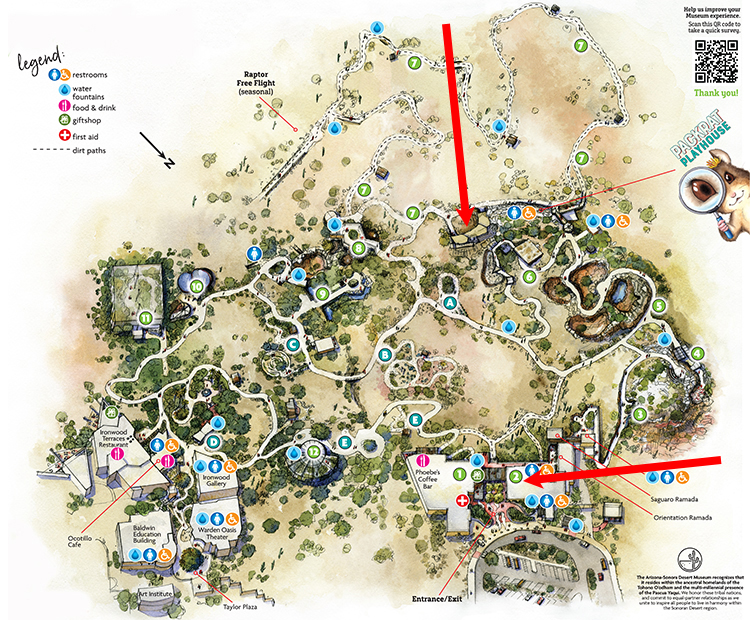
Find Gila monsters at Life on the Rocks or the Reptiles and Invertebrates room.
Gila monsters are occasional stars of the Sonoran Animal Spotlight, so check it out in the Warden Oasis Theatre when you visit.


